
Solar isn't complicated once you see how the parts connect. Here's the whole flow, in plain English.
From the sun to your appliances. Here's how energy moves through a solar system.

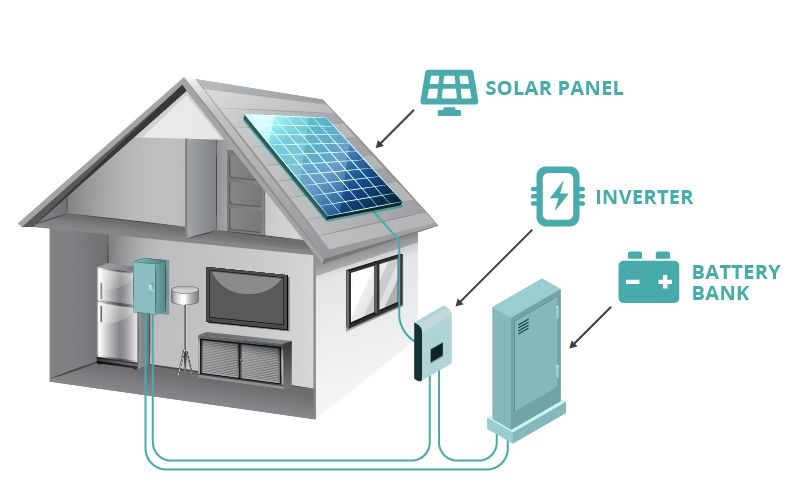
Solar photovoltaic (PV) panels are installed on your roof and face the sun. When sunlight hits the silicon cells, it creates a flow of electrons that generates DC (Direct Current) electricity. Modern monocrystalline panels (Canadian Solar, JA Solar) perform well even on overcast days.
Your appliances run on AC (Alternating Current), not DC. The inverter converts the DC power from your panels into usable AC power. Modern hybrid inverters (Sunsynk, Deye) also manage the power flow between panels, batteries, and the grid.

In a hybrid or off-grid system, excess solar energy not used immediately is stored in lithium batteries (REVOV, BSL Powerwall). That stored energy runs the house at night, on overcast days, and through loadshedding, regardless of what the grid is doing.
AC electricity flows to your distribution board and powers your home the same way grid power would, just cleaner, cheaper, and more reliable. With a properly sized system, most of your daily electricity comes from solar during daylight hours, and batteries cover the rest.
Three different approaches to solar, each with its own trade-offs. We help you pick the one that fits.
Connected to the municipal grid. Solar reduces your bill during the day, but you won't have backup power during loadshedding without batteries.
Solar panels, batteries, and grid connection working together: maximum savings and full loadshedding protection.
Completely independent from the municipal grid. Relies entirely on solar panels and batteries. Ideal for remote properties or those wanting full energy independence.
It depends on your daily electricity usage, roof size, and which appliances you want to power. We conduct a free site assessment to calculate the right system size for your home or business.
Yes. Modern monocrystalline panels still generate on overcast days, just at reduced output. Your battery bank stores excess energy from sunny periods to cover low-generation days.
Quality solar panels like Canadian Solar carry a 15-year product warranty and are designed to produce at 80%+ of rated output for 25+ years. This makes solar one of the best long-term investments available.
With a hybrid or off-grid system and a battery bank, your home or business switches to battery power the moment the grid fails. Most people don't notice the switch.
Absolutely. All our packages are designed with future expansion in mind. You can add more panels, extra batteries, or upgrade your inverter as your energy needs grow.
Every installation includes a Certificate of Compliance (CoC). Depending on system size and municipality, additional approvals may be required, and we guide you through that process.
A hybrid inverter manages power from three sources simultaneously: solar panels, batteries, and the grid. It intelligently prioritises solar energy, charges batteries with surplus power, and draws from the grid only when needed.
For a cash purchase, typical ROI is 3–4 years. On a financed system, around 4–5 years. After payback, you're generating essentially free electricity for the remaining 20+ year system life.